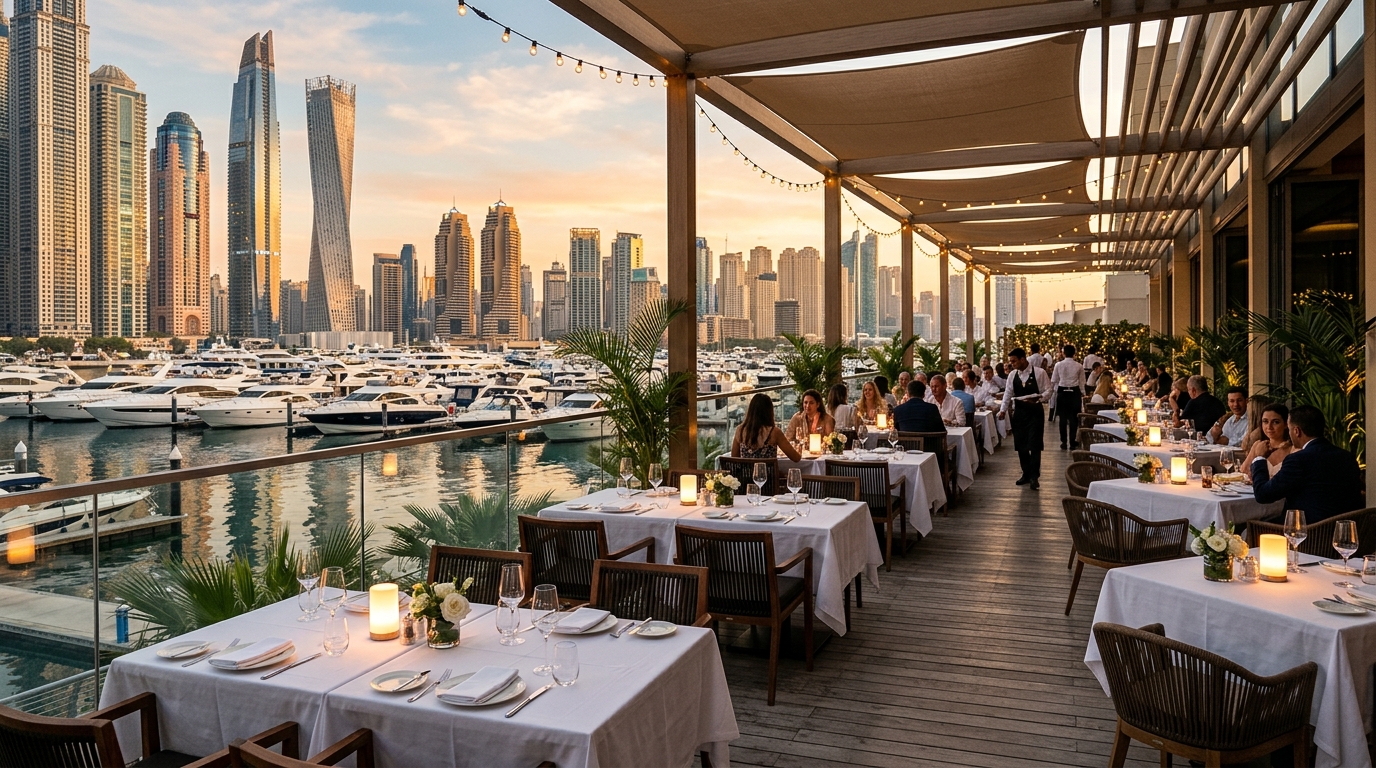
Dining, retail & thelong-evening island
The measure of a place to live isn't the postcard view — it's the ordinary Tuesday. Here's how Palm Jebel Ali is planning its restaurants, shops and lifestyle districts around the people who actually live there.
- Developer
- Nakheel
- Island scale
- 16 fronds · 7 islands
- New coastline
- 110km
- Dining
- Waterfront precincts by the marinas
- Retail
- Boutique clusters + lifestyle centres
- Scaled for
- Residents, not tour buses
- Essentials
- Community retail on every frond
- Delivery
- Phased, alongside the residences
Ask anyone who has lived on a waterfront island and they'll tell you the same thing: the view is what sells the address, but the coffee is what keeps you there. A great morning walk that ends at a good flat white. A grocer close enough to leave the car at home. A stretch of promenade that fills up at dusk rather than emptying out. These are the small, unglamorous things that turn a beautiful map into a place with a pulse.
Palm Jebel Ali is being planned with that ordinary rhythm in mind. Across its 16 fronds and seven islands, the dining, retail and lifestyle layer isn't an afterthought bolted on once the villas are sold — it's woven into the master plan as the connective tissue between homes and the sea. This guide walks through how everyday life is being scaled here: where you'll eat, where you'll shop, and, crucially, who it's all being built for.
Everyday life on the island
Start with the coastline. Palm Jebel Ali adds around 110km of new shoreline to Dubai — a figure that only lands when you realise how much edge that gives you to work with. Edge is where life happens on a waterfront island: the promenades, the marina fronts, the beach walks. More coastline than any single frond could ever need means the lifestyle layer can be spread out rather than stacked into one crowded strip.
The intent reads clearly from the plan. This is a place designed for long, slow evenings — where you can leave the house on foot, wander a waterfront precinct, settle in for dinner as the light goes, and drift home along a promenade rather than through a car park. It's the difference between a district you visit and a district you live in.
Waterfront dining districts
The dining scene is being organised around the water, and specifically around the marinas. Rather than scattering restaurants at random, the plan wraps dining precincts along the marina fronts — the natural gathering points on any island, where the boats come in, the promenade widens, and the evening naturally slows down.
It's a deliberate piece of choreography. A marina gives a dining district a reason to linger: masts and moored boats, water on two sides, a walk that unfolds rather than ends. Precincts built around that setting are designed for the long evening — an unhurried dinner, a drink after, a walk before bed — instead of the quick in-and-out of a food court. The water isn't the backdrop to the meal; it's the reason the meal takes three hours.
How the lifestyle layer is organised
Three distinct tiers, each doing a different job — from the long-evening waterfront precincts down to the grocer at the end of your frond.
By the marinas
Waterfront dining precincts
Restaurants and cafes wrapped around the marina fronts, built for long evenings by the water rather than quick turnover. The island's social heart.
Lifestyle centres
Boutique retail clusters
Smaller, curated retail gathered into walkable lifestyle centres — the kind of shopping you fold into an evening stroll, not a weekend expedition.
Community retail
Everyday essentials
The unglamorous, indispensable layer: grocers, pharmacies and daily-needs retail placed close to home so the ordinary day never requires leaving the island.
Boutique retail & lifestyle centres
Retail here is being kept deliberately human in scale. Instead of a single mega-mall pulling all the footfall to one point, the plan favours boutique clusters gathered into lifestyle centres — smaller, curated pockets of shops, cafes and services distributed across the island so that something good is always a short walk away.
That scale is a design choice with a purpose. A boutique cluster invites the evening stroll: browse a little, stop for a coffee, drift toward dinner. It rewards residents who are here every day and want a district that feels like theirs, rather than one engineered to absorb the maximum number of visitors in the shortest time. The lifestyle centre becomes a place you pass through habitually, not a destination you brace yourself for.
“The view is what sells the address. The coffee is what keeps you there.”
Scaled for residents, not tour buses
This is the quiet distinction that shapes everything above. Dubai has landmark districts built to receive the world — vast, spectacular, and, on a normal weeknight, not entirely yours. Palm Jebel Ali's lifestyle layer is being sized to the people who live on the island first.
You feel that difference in the details. Precincts scaled for residents mean a table you can get on a Tuesday, a promenade that isn't shoulder-to-shoulder, a shop where the staff start to know you. It doesn't mean the island turns its back on visitors — the wider master plan makes room for hospitality at scale. It means the everyday texture of the place is calibrated for the resident's ordinary week rather than the tour bus's peak hour. On an island, where you can't simply drive somewhere quieter, that calibration is the whole game.
The everyday-essentials layer
Beneath the dining precincts and the boutique clusters sits the layer that actually makes an island livable: community retail. The grocer, the pharmacy, the daily-needs shops — the things you don't photograph but can't do without. Spreading this essentials layer across the fronds rather than concentrating it in one hub is what lets residents genuinely live here, not just holiday here.
It's the least glamorous part of the plan and arguably the most important. A waterfront is only a home if a carton of milk is a five-minute errand rather than a bridge crossing. By threading everyday retail through the community fabric — close to where people actually live — the island is designed to hold its own gravity, so daily life orbits the fronds instead of constantly pulling back to the mainland.
Phased delivery
None of this arrives all at once, and it's worth being straight about that. Like the residences, the dining, retail and lifestyle districts are delivered in phases — the amenity layer comes online alongside the homes as each part of the island matures, rather than switching on fully formed on day one.
For an early buyer, that's the honest trade: the first residents move into a place still finding its rhythm, with the full precincts, clusters and centres filling in over the phased build. The upside is being there as it grows — watching an island's social life take shape around you. If you want a district that's already busy and complete from your first evening, that's a later phase, and a conversation worth having about timing before you commit.
Frequently asked questions
What will dining be like on Palm Jebel Ali?
Dining is planned around the water — waterfront precincts wrapped along the island's marina fronts, designed for long, unhurried evenings rather than quick turnover. The marinas act as natural gathering points, giving each dining district a promenade, a view and a reason to linger.
Will there be shopping and retail on the island?
Yes. Rather than one large mall, the plan favours boutique retail clusters gathered into walkable lifestyle centres distributed across the island, plus an everyday-essentials layer of community retail — grocers, pharmacies and daily-needs shops — placed close to home on the fronds.
Is Palm Jebel Ali built for tourists or residents?
The lifestyle layer is scaled for the people who live there first — precincts sized for a resident's ordinary week rather than peak-hour tour-bus footfall. The wider master plan still makes room for hospitality at scale, but the everyday dining and retail texture is calibrated for residents.
Can I handle daily errands without leaving the island?
That's the intent. An everyday-essentials layer of community retail is threaded across the fronds, close to where people live, so groceries, pharmacies and daily needs are a short walk rather than a mainland trip. It's the layer designed to make the island genuinely livable day to day.
When will the restaurants and shops open?
The dining, retail and lifestyle districts are delivered in phases, alongside the residences, so the amenity layer comes online as each part of the island matures rather than all at once. Early residents move in as the island is still finding its rhythm, with precincts and centres filling in over the phased build.
Picture the ordinary Tuesday, not just the postcard
If it's the lived-in feel of the island you care about — where you'd eat, walk and shop day to day — tell us how you'd use it and we'll talk you through how the lifestyle layer is shaping up.