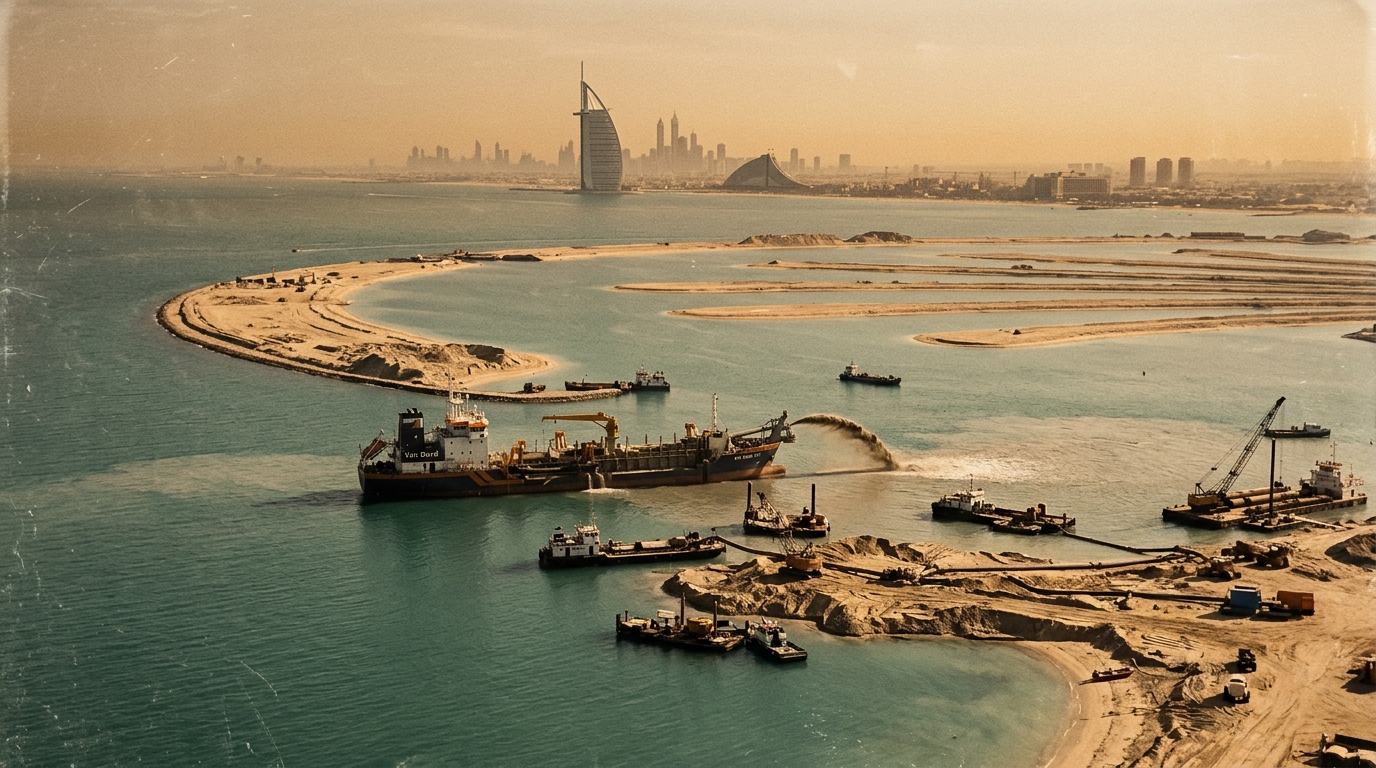
Palm Jebel Ali,Dubai's most patient landmark
Announced in the early 2000s, paused after the global crisis, and redrawn for its 2023 relaunch — this is the long arc behind the second, larger palm, and why the wait is part of what makes it worth watching.
- Developer
- Nakheel
- First announced
- Early 2000s (around 2002)
- Paused
- After the 2008-09 crisis
- Relaunched
- 2023, redesigned
- Scale
- 16 fronds · ~2× Palm Jumeirah
- Coastline
- Around 110km
- Status
- Under construction
- First handovers
- Phased, from 2027
Most Dubai landmarks are told as overnight stories: a rendering, a launch, a ribbon. Palm Jebel Ali is the exception. It is the city's most patient landmark — an island first imagined more than two decades ago, built partway, then set down for years, and finally picked back up and redrawn for the Dubai that had grown up around it in the meantime.
That long arc is not a footnote. It shapes what the island is today, why it looks the way it does, and why buyers who understand the story tend to read the current moment differently from those seeing only the latest brochure. To make sense of Palm Jebel Ali now, it helps to walk through how it got here.
The original vision
In the early 2000s — around 2002 — Nakheel announced a second palm-shaped island off Dubai's coast, this one at Jebel Ali, to the south of the original Palm Jumeirah. The concept was deliberately more ambitious than its predecessor: a larger island, more fronds, more coastline, conceived at a moment when Dubai was reimagining what a coastline could be through land reclamation.
Through the mid-2000s, reclamation progressed and the outline of the island began to take shape in the water. It was, at the time, part of a wave of headline projects that defined that era of the city's growth — audacious in scale and sold on the promise of a skyline and shoreline that did not yet exist. The ambition was never in doubt; what came next was a test of timing.
The island, era by era
Four broad chapters, hedged to what is widely and publicly known — the announcement, the pause, the relaunch, and where things stand now.
Early 2000s — The announcement
Nakheel announces a second, larger palm island at Jebel Ali, south of Palm Jumeirah. Reclamation gets under way and, through the mid-2000s, the island's shape starts to emerge offshore.
2008-09 — The pause
The global financial crisis and Dubai's property downturn arrive as the island is still taking form. Work stalls, and Palm Jebel Ali becomes one of the era's most visible paused projects — reclaimed land waiting on a market that had turned.
2023 — The relaunch
Nakheel relaunches the island with a redesigned master plan and begins villa sales. It returns larger and rethought — roughly twice the size of Palm Jumeirah, with 16 fronds and around 110km of coastline.
Today — Under construction
The island is being built out, with a phased handover expected to begin from 2027. Early collections are selling off-plan while infrastructure and the first residences take shape.
The pause
The story's turning point came with the 2008-09 global financial crisis and the property downturn that followed in Dubai. The island was still emerging from the water when the market that would fund and fill it contracted sharply. Work on Palm Jebel Ali stalled, and for years the reclaimed land sat as one of the most visible symbols of a city that had built ambitiously into a cycle that turned.
It is worth being measured about this chapter. What is widely known is simply that the project was paused in the wake of the crisis and remained largely dormant for an extended stretch. Rather than a failure, in hindsight it reads more like a project that arrived at the wrong point in a cycle — the land was there, the demand and the timing were not yet. Dubai spent the following years recovering, maturing, and expanding southward, and the island waited.
“The land never went anywhere. What changed was the city that grew up around it — and, eventually, the plan drawn on top of it.”
The relaunch
In 2023, Nakheel relaunched Palm Jebel Ali, this time with a redesigned master plan, and villa sales began. It returned not as a revival of the original drawings but as a reconsidered island — larger and rethought for a Dubai that had changed considerably since the first announcement. The relaunch reframed the project from a paused ambition into an active, phased development.
The island came back bigger. In its current form Palm Jebel Ali is roughly twice the footprint of Palm Jumeirah, laid out across 16 fronds and adding around 110km of new coastline — against roughly 56km for the original palm. Where the first island proved the concept, the second was scaled up to a different order of magnitude entirely, and positioned against the southern growth corridor the city had been building toward during the pause.
The island by the numbers
Where it stands today
Today Palm Jebel Ali is under construction. The relaunched collections are selling off-plan while the developer builds out infrastructure and the first residences, with a phased handover expected to begin from 2027 and later phases following as the island completes. It is, in other words, back in motion — no longer a paused idea but a live build with a timeline.
That status matters for how you read it. The island is neither the finished, proven address that Palm Jumeirah has become nor the dormant land it was for much of the 2010s. It sits in between: a large, redrawn master plan being delivered in stages, early enough that the shape of the finished island is still being set, far enough along that the direction is committed.
Why the story matters to a buyer
The history is not just colour — it carries two things a buyer can actually use. The first is the developer. Nakheel is the same name behind Palm Jumeirah, the island that turned reclaimed sand into one of the most recognised addresses on earth. Palm Jebel Ali is being delivered by a developer with a completed, proven palm already standing a little to the north — a track record that is rare for a project of this ambition.
The second is timing. Palm Jumeirah's story is, in part, a story about its earliest buyers: those who committed before the island was proven captured the most as it matured. Palm Jebel Ali offers something unusual — a second chance to buy into an icon at an early, launch-stage moment, on a version of the island that is larger than the first. History rhymes rather than repeats, and a far bigger island takes longer to mature, so this is a long-horizon read, not a guarantee. But the patience baked into the story is precisely what puts a buyer at the early end of the curve today.
Frequently asked questions
When was Palm Jebel Ali launched?
It was first announced by Nakheel in the early 2000s — around 2002 — as a second, larger palm island south of Palm Jumeirah. After being paused for years following the 2008-09 crisis, it was redesigned and relaunched in 2023, when villa sales began.
Why was Palm Jebel Ali delayed?
The project stalled in the wake of the 2008-09 global financial crisis and the Dubai property downturn that followed. Reclamation had progressed through the mid-2000s, but work paused as the market contracted, and the island remained largely dormant for an extended period before its 2023 relaunch.
Who is building Palm Jebel Ali?
Nakheel, the same developer behind Palm Jumeirah. That earlier, completed island is widely seen as the proof of concept for what Nakheel is now delivering at a larger scale at Jebel Ali.
How is the relaunched island different from the original plan?
The 2023 relaunch came with a redesigned master plan rather than a straight revival of the early-2000s drawings. In its current form the island is roughly twice the size of Palm Jumeirah, with 16 fronds and around 110km of coastline — reconceived for a Dubai that had changed significantly during the pause.
Is Palm Jebel Ali finished?
No. The island is under construction. Collections are selling off-plan while infrastructure and the first residences are built, with a phased handover expected to begin from 2027 and later phases following as the island completes.
Why does the history matter if I'm thinking of buying?
Two reasons. It is being delivered by a proven developer with a completed palm island already standing, and its long pause means today's buyers are entering at an early, launch-stage point on a larger second icon. As with any off-plan purchase, that early entry comes with a long horizon and construction risk rather than a guaranteed outcome.
Want the story behind the island in person?
We track Palm Jebel Ali from its history to its current releases. Ask us anything — where it came from, where it's going, and where you might fit.